
Under a driveway, not on top of it
Caliche broken out, subgrade compacted, forms set to a line that sheds water away from the garage. Everything that decides whether a driveway is still flat in ten years happens before any concrete arrives.
Service
A driveway is the largest slab most homes will ever have, and the one that carries the heaviest load. Tear-out and replacement, a first pour on a bare lot, or an extension for a second vehicle — the part that decides how it ages is all underneath it.
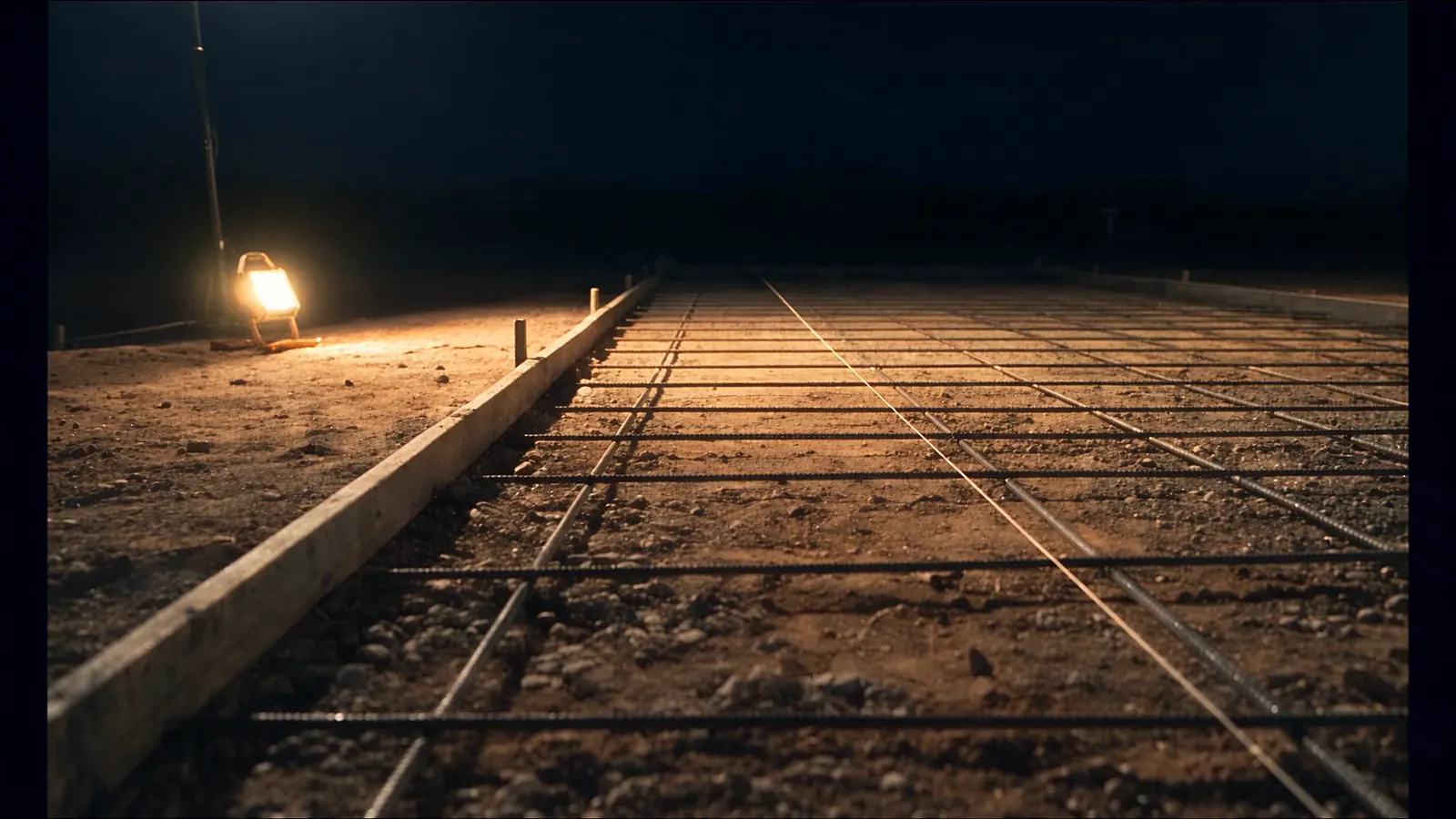
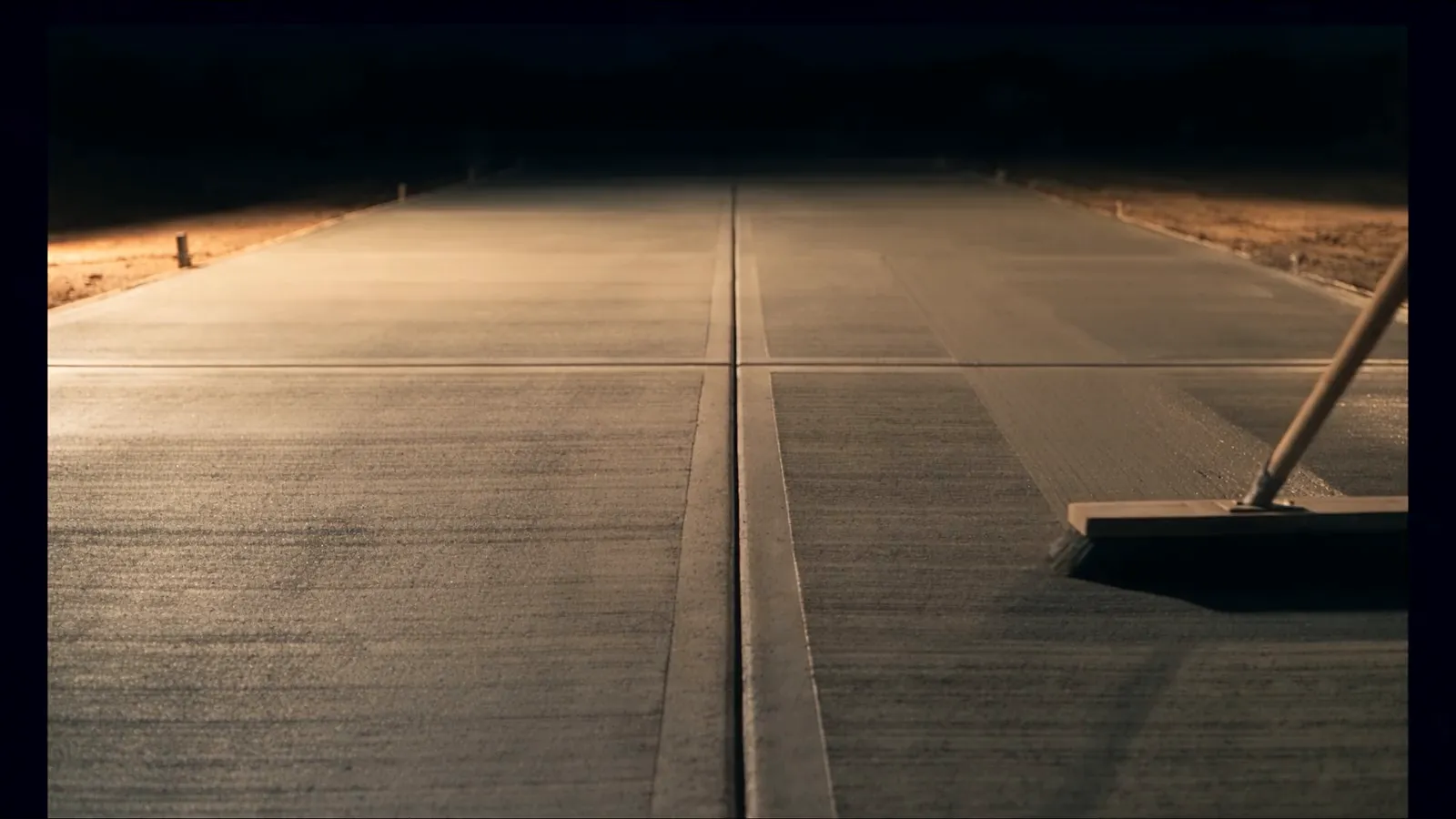
Caliche broken out, subgrade compacted, forms set to a line that sheds water away from the garage. Everything that decides whether a driveway is still flat in ten years happens before any concrete arrives.
Thickened edges where wheels track on and off. Steel on chairs through the middle. Joints tooled or sawn where the slab is going to move anyway, so it cracks on a line instead of across the middle.
Detail
Four inches is the residential standard for cars and light trucks. Anything that will see a dually, a loaded trailer, a motorhome or a delivery truck gets five to six inches, and the approach where wheels turn in gets thickened whether or not the rest does. Paying for two extra inches once is cheaper than replacing a cracked slab.
Rebar tied and set on chairs so it sits in the slab rather than on the dirt. Wire mesh laid flat on grade does nothing — by the time the concrete is around it, it is at the bottom, which is the one place it cannot help. Where a driveway meets a garage slab or a public sidewalk we dowel the joint so the two do not part company.
Concrete cracks. The only question is whether it cracks where you chose or where it chose. Control joints go in at roughly two and a half times the slab thickness in feet — about ten feet apart on a four inch slab — and get tooled during finishing or sawn early the next morning. Panels get kept close to square, because long thin panels crack across the middle.
Slope is set before the forms are nailed. Water leaves the garage, not the other way around, and it goes somewhere it can keep going. In this county that matters more than most places: monsoon runoff spreads across alluvial fans as sheet flow rather than staying in a channel, and a driveway graded the wrong way becomes a funnel pointed at the house.
Broom finish across the driving surface is the standard here and the right call — it holds traction when a summer storm dumps an inch in twenty minutes. Trowel-smooth belongs indoors. Exposed aggregate and banded borders are available if you want the driveway to look like more than a parking surface.
Local conditions
Above about 3,000 feet — Kingman, Valle Vista, Dolan Springs, Chloride — overnight lows sit at or below freezing through much of the winter. That means air-entrained concrete and real curing, because a slab that freezes before it has strength spalls at the surface and never stops.
Down in the river valley — Bullhead City, Fort Mohave, Mohave Valley, Lake Havasu City — the problem inverts. July highs average around 110°F. Concrete stiffens fast, water leaves the surface faster than it bleeds up, and plastic shrinkage cracks open while it is still soft. The answer is early starts, mix adjusted for the day, and finishing crews sized so nobody is chasing the slab.
Caliche is the other constant on the upland side. Where a hardpan layer sits under the topsoil it has to come out rather than be poured over, because it will not compact evenly and the slab will find the soft spots.
Questions
Four inches for cars and light trucks; five to six inches where an RV, a dually or a loaded trailer will sit or turn. The apron and any spot where wheels pivot are worth thickening regardless.
In unincorporated Mohave County, driveways and sidewalks are exempt from a building permit as long as they are not more than 30 inches above the adjacent grade, not over a story below, and not part of an accessible route. Work inside a county right of way needs a separate Right of Way Use Permit, and grading of 100 cubic yards or more needs a grading permit. Incorporated cities set their own rules — Lake Havasu City has a dedicated residential driveway permit. Confirm before we start; we are happy to help you sort out which applies.
Foot traffic the next day. Cars after about seven days. Anything heavy — a motorhome, a concrete truck, a loaded trailer — waits the full 28 days. Concrete reaches most of its strength early but not all of it, and the last stretch is the part that carries weight.
Often, yes. If the rest of the slab is sound and the cracking is confined to a panel or two, we saw cut on the joints, take out the bad panels and pour back. If the subgrade is what failed, patching buys a year or two and then you are back where you started — we will tell you honestly which one you are looking at.
Also
Where
Free estimate
Estimates are free and there is no obligation attached to one. If you would rather just talk it through, the phone is faster than the form.
Received
Usually the same day, and always within one working day. If it is urgent, calling is quicker than waiting on us.